Render
The render component enables an entity to render primitive shapes or render assets.
The render component can be enabled or disabled using the toggle in the top-right of the component panel. When enabled, the mesh instance referenced by the component is added to the scene and rendered.
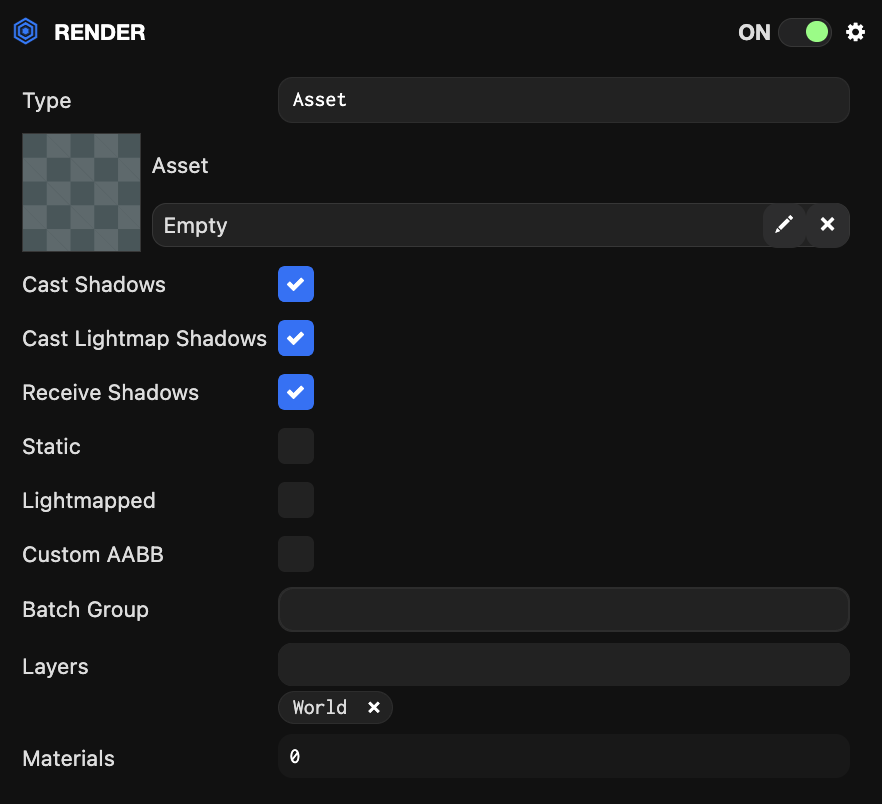
Properties
| Property | Description |
|---|---|
| Type | The type of graphics object to render. Can be one of:
|
| Asset | The render asset to render in this render component. Only applies when the type property is set to 'Asset'. Only a single render asset can be assigned to a render component. |
| Cast Shadows | When enabled, the mesh instance rendered by this component casts shadows on other mesh instances in the scene. |
| Cast Lightmap Shadows | When enabled, the mesh instance rendered by this component casts shadows on the lightmap. |
| Receive Shadows | When enabled, the mesh instance rendered by this component receives shadows cast by other mesh instances in the scene. |
| Static | If the entity referencing this render component will never move, check this box to give the engine hints to perform certain optimizations. |
| Lightmapped | When enabled, this component's mesh instance does not receive lighting from dynamic lights. Instead, it receives lighting generated by lightmap baking. |
| Custom AABB | When enabled, a user-provided bounding box is used for visibility culling of the associated mesh instance. This is an optimization that allows specifying an overly large bounding box to avoid per-frame bounding box calculations based on bone positions for skinned characters. |
| Batch Group | The batch group this component's mesh instance belongs to. |
| Layers | The layers the mesh should belong to. |
| Materials | The material assets used to render this component's mesh instance. Each material corresponds to the respective mesh instance. |
Scripting Interface
You can control the render component's properties using a script component. The render component's scripting interface is here.